
Hello beautiful soul
Recently, the article titled Is Having a Boyfriend Embarrassing Now? went viral. I am pretty sure most people heard about it.
You can have your own view on it. Plenty of people do. But the part that landed for me wasn’t really about boyfriends. It was about performance.
Women are becoming allergic to the performance of being chosen.
Which raises the next question.
If having a boyfriend is embarrassing, does that mean seeking men’s validation (or the patriarchal workplace system) is embarrassing next?
Not in a shaming way.
In a liberating one.
Because women have been trained to organise their entire lives around male or patriarchal approval.
And work is one of the most sophisticated places this happens.
We learn to scan the room. To soften. To self-edit. To become “not difficult”. To be likeable. To be chosen by the right men for the right projects and promotions.
We call it leadership.
But often it’s just survival dressed up as ambition.
And the cost is always the same. A slow, quiet separation from ourselves.
This is where I want to pause and say this.
So many of the struggles women experience at work are not personal shortcomings.
They are the result of a small set of deeply embedded lies we’ve been sold about leadership, ambition, confidence, and success. Beat with me for a minute on this.
For a long time, I didn’t know I was being limited because I was a woman.
When I was at Shazam, right up until around 2013 or 2014, I was so busy surviving my life and internalising everything that it never occurred to me that the limits I was bumping into at work might be structural.
I made it mean something about me.
If I felt overlooked, I assumed I hadn’t earned my seat yet.
If I didn’t feel safe to speak, I assumed I needed to become braver.
If I felt tired and stretched and quietly dissatisfied, I assumed I just wasn’t resilient enough.
Survival mode is like that. You don’t have the bandwidth to question the water you’re swimming in. You just learn how to breathe in it.
At that point in my career, I’d been in recruitment for around fifteen years. I had always cared deeply about access. About who got opportunities and who didn’t.
But I’d mostly looked at inequality through a racial lens and a cultural lens.
Gender was there. I just wasn’t really seeing it. Then Sheryl Sandberg published Lean In.
She might be less popular today, but at the time that book blew my mind open. It gave me language for something I hadn’t yet been able to name.
Oh. Wait. Hang on. Is it different?
That question changed everything.
Because once you can see that the playing field isn’t level, you stop interpreting every struggle as a personal failing. You stop assuming you’re uniquely flawed. You start noticing patterns.
And with that awareness, I did what many women did in that era. I set about trying to bring more women into the system.
I tried to bring more women into Shazam. I wanted the numbers to change. I wanted the outcomes to change. I wanted the future to change.
And I still believe that work matters. Representation matters. Opportunity matters.
But here’s the truth that only landed later.
What Lean In was really teaching women to do was how to survive inside systems that require us to contort ourselves.
Lean in. Be bolder. Be louder. Be more assertive. Take the seat.
And sometimes that works.
But it also quietly trains women to lean further away from the truth of who they are in order to be taken seriously.
To become more palatable. More masculine-coded. More performative. More “professional”. More acceptable.
I teach the OPPOSITE today. I teach women to lean into the truth of who they are, whatever that means.
And when women do that, two things tend to happen.
1. Many of the women I work with go on to have extraordinary careers inside organisations. Not because they’ve become better at performing leadership, but because they become more aligned, more boundaried, more embodied, and far more honest.
2. And many of the women I work with set themselves free. They leave. They pivot. They build. They choose a life that doesn’t require self-abandonment.
Which brings me to Whitney Wolfe Herd.
Whitney was instrumental in the early rise of Tinder. She helped build it. She helped grow it. And then she experienced what so many women experience when they’re building something inside a boys’ club.
Harassment. Humiliation. Being pushed out of the very thing you helped create.
She didn’t lean in harder to earn the respect of a system that had already shown her what it was. She stepped out.
And she built Bumble, designed around one simple but radical structural shift.
Women make the first move.
Not as a gimmick.
As a correction.
She didn’t just talk about empowerment. She built it into the architecture.
This is what I mean when I say we can make our own rules. We can create our own systems.
Not to shame women.
And definitely not to fix women.
But to finally name what’s actually going on, so you can stop blaming yourself and start making different choices.
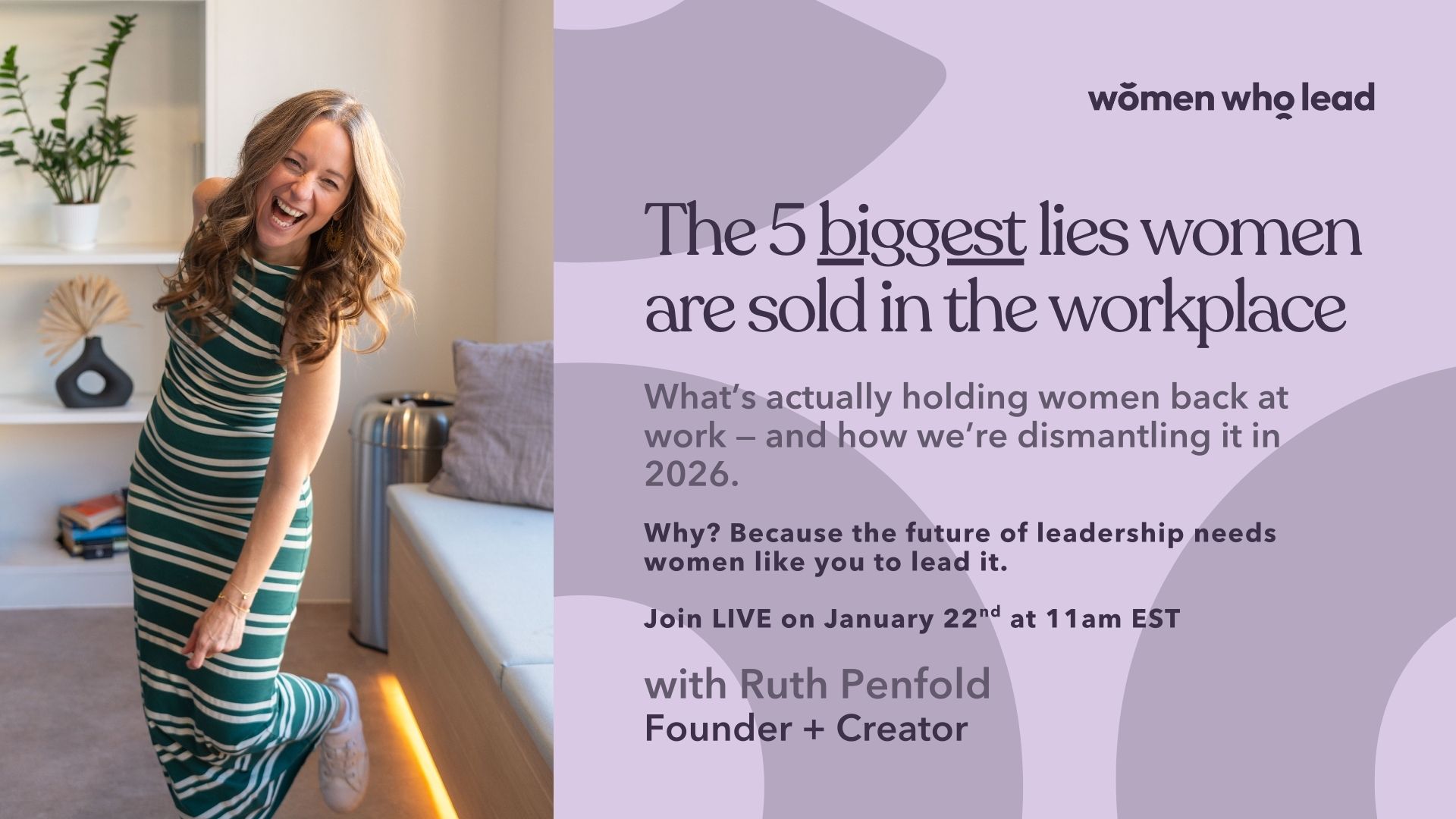
If this email stirred recognition, frustration, or a quiet oh… that’s me, this workshop is for you. Grab your spot for January 22nd here.
For now, just notice what you’re starting to question.
That’s always where change begins.
Rooting for you always
Ruth x


Responses